

Respirex™ launches ESD version of the GTR Tychem® TK gas-tight suit for ATEX environments
18 November 2026
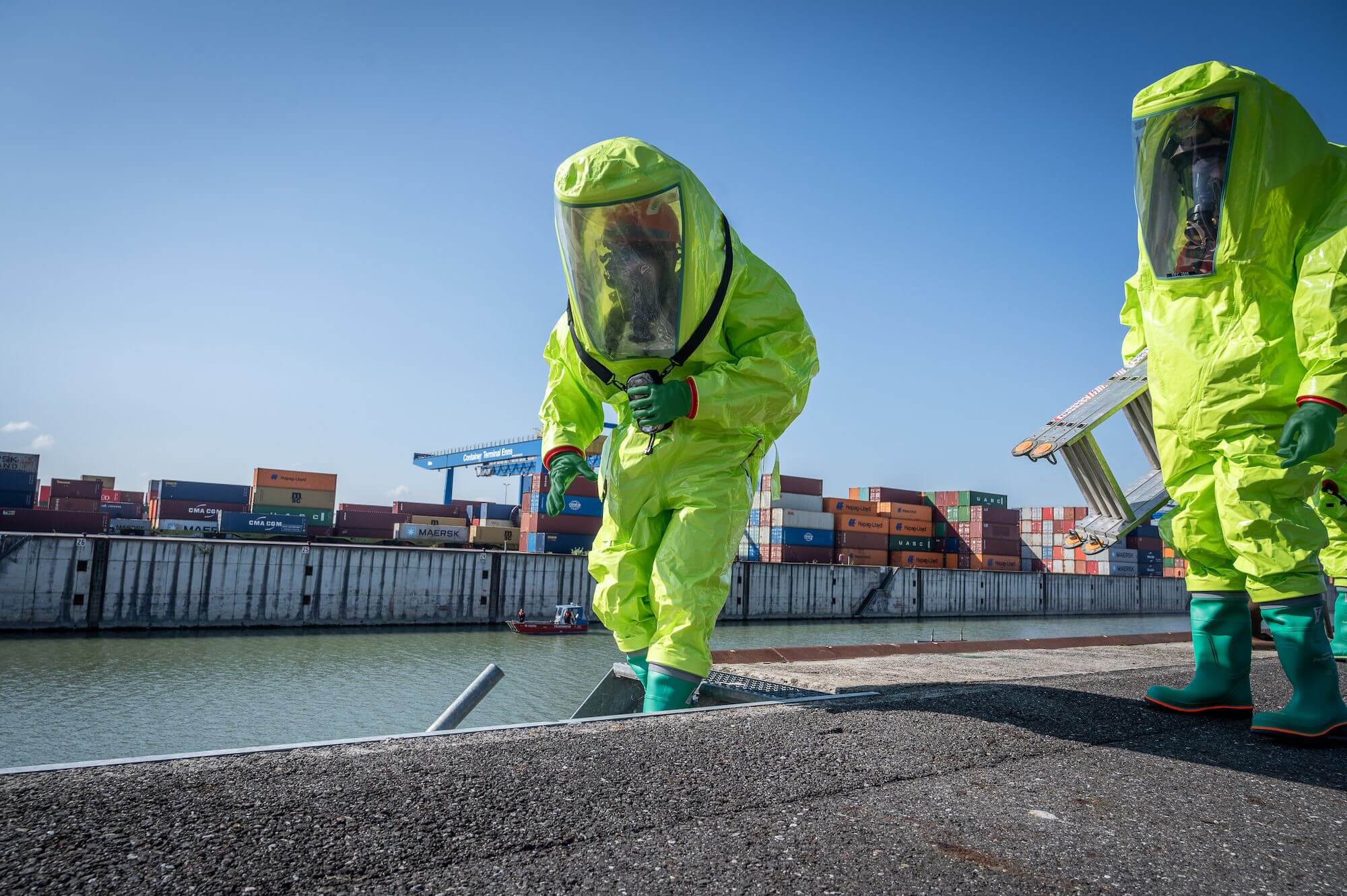
Respirex™ has introduced a new Electrostatic Dissipative (ESD) version of its GTR encapsulating gas-tight suit, made from DuPont™ Tychem® TK. Tested for use in potentially explosive (ATEX) atmospheres, the new suit provides emergency responders with EN 943-2 gas-tight chemical protection while controlling the build-up of static electricity – a hidden but potentially significant ignition risk at hazmat incidents. The ESD version of the GTR combines conductive Kemblok™ inner chemical barrier gloves with an antistatic over-glove for mechanical protection, Hazmax™ ESD FPA boots, and covers for the exhalation valves.
Tested for explosive atmospheres
The ensemble has been tested in accordance with EN IEC 60079-32-2:2015 and CEN/CLC/TR 16832:2015 and is suitable for use in the following ATEX zones:
Dust Ex atmospheres: ZONES 20, 21 & 22*
Gas Ex atmospheres: ZONES 0, 1 & 2**
* A risk assessment will be required in conductive dust environments.
** Subject to restrictive clauses – please contact Respirex™ for details.
Why ATEX-tested PPE matters for emergency responders
Emergency responders rarely get to choose their environment. Fuel and chemical spills, gas leaks, tanker incidents and fires at industrial sites can all create flammable gas, vapour or dust atmospheres – often before the full picture is known on arrival.
In these conditions, static electricity is a real and often overlooked hazard. The wearer's movement, friction between suit materials and the handling of equipment can all generate static charge on protective clothing. If that charge discharges as a spark, it can carry enough energy to ignite many flammable gases and vapours, some of which need only a fraction of a millijoule to ignite.
An ESD-tested ensemble addresses this risk by allowing static charge to dissipate safely rather than build up on the wearer. That brings practical benefits at the scene. Crews can enter zoned areas with greater confidence that their PPE will not become an ignition source. Incident commanders gain a tested, documented basis for PPE selection as part of their risk assessment. And because the suit has been tested as a complete ensemble – suit, gloves and boots – there is no need to piece together a compatible combination of components on the day. As with all ESD protective clothing, the ensemble relies on a path to earth through the wearer's footwear, so ground conditions should form part of the risk assessment.
ATEX zones classify hazardous areas by how likely an explosive atmosphere is to be present. Zones 0 and 20 are the most demanding, where an explosive gas or dust atmosphere is present continuously or for long periods. Suitability across Zones 0, 1 and 2 for gas and Zones 20, 21 and 22 for dust means the suit can be deployed across the full range of zoned environments, subject to the conditions noted above.
Uncompromised chemical protection
The suit maintains its EN 943-2:2019 Type 1a-ET approval for emergency team use, so the addition of ESD performance comes with no trade-off in chemical protection. Tychem® TK provides a proven barrier against a broad range of toxic industrial chemicals, gases and liquids.
To find out more about the ESD version of the GTR gas-tight suit, or to discuss your requirements, contact the Respirex™ team on +44 (0)1737 77 86 00 or at info@respirex.co.uk.
Respirex™, Kemblok™ and Hazmax™ are trademarks of Respirex™ International Limited. Tychem® is a registered trademark of DuPont de Nemours, Inc.
View News and Events